
<
  • Blog
  • Window, door and roller shutter optimisation software

Optimisation as an operational advantage: windows, doors and roller shutters in modern production


The article describes among others:
  1. Which areas of optimisation are of greatest importance in companies manufacturing windows, doors and roller shutters
  2. How Stolcad® Professional supports optimisation of material management, production processes and work organisation
  3. What business results are delivered by well-planned and consistently implemented optimisation

Optimisation in a window, door or roller shutter manufacturing company

Optimisation is the purposeful structuring of activities and processes to achieve the best possible outcomes within given resources and conditions. In practice, in companies manufacturing windows, doors and roller shutters, it focuses on three main areas:

  • optimisation of material management – particularly in terms of cutting layouts and minimising waste,
  • optimisation of production and logistics processes – improving workflow, shortening lead times and eliminating downtime,
  • optimisation of business and work organisation – better management of orders, resources and communication within the company.

Business optimisation is a multi-faceted process that covers technology, organisation and management. If implemented at an early stage, it quickly brings measurable benefits, including lower production costs, shorter lead times and enhanced quality of the final product. This, in turn, directly affects the company's competitiveness.
In this article, we will show how modern Stolcad® Professional software supports companies in effective optimisation and helps them achieve measurable results in a short time.


Optimisation of material management with Stolcad® Professional

The importance of material management in production costs

In the production of windows, doors and roller shutters, material management is one of the most important factors affecting financial performance. Material accounts for a significant share of manufacturing costs, which is why any inefficiency in its planning and use directly reduces margins. The scope of challenges goes beyond waste generated during cutting. It also includes demand planning, organisation of warehouse management and adjustments made at the production stage. Together, these elements determine actual material consumption and the level of costs.
From this perspective, optimisation of material management means managing material throughout the entire process – from order preparation to production execution. Its aim is to maximise the use of available resources and increase predictability of consumption. Stolcad® Professional supports this area by organising material data already at the order preparation stage and integrating it with subsequent technological processes. As a result, material decisions become part of a coherent, controllable process that can be analysed and optimised across the entire company.

Cutting optimisation as the foundation of savings

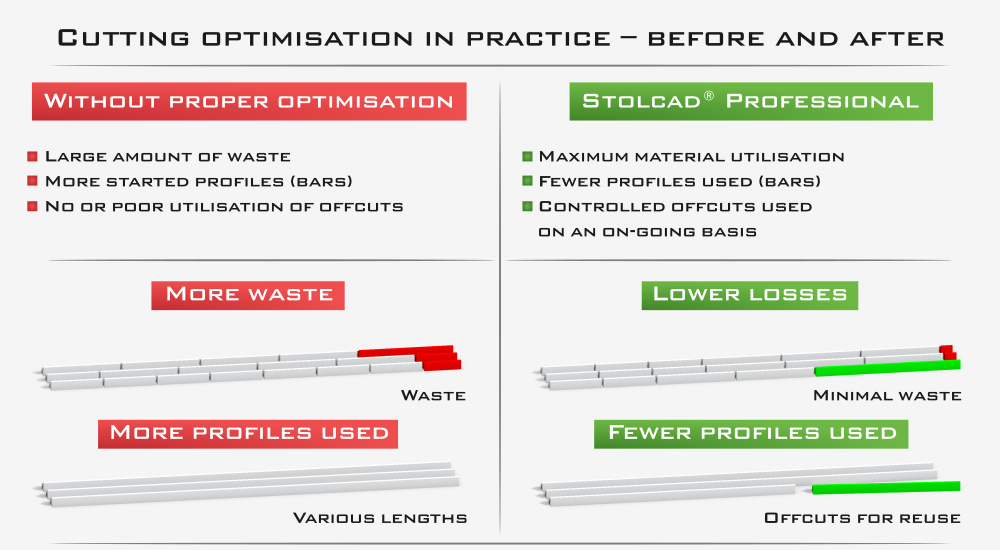
Cutting optimisation in Stolcad® Professional is based on automatic generation and analysis of multiple cutting variants for a given order or set of orders. The system works directly on design data, taking into account actual stock lengths, technological parameters and production assumptions. In practice, this means that for one set of elements, Stolcad® Professional creates and compares different cutting layouts, selecting those that ensure the highest level of material utilisation. This process is carried out automatically, repeatably and based on clearly defined criteria.
Stolcad® Professional efficiently optimises cutting across the entire production, enabling more effective use of material and reducing the number of profile bars used. The software also takes into account parameters affecting actual cutting execution, such as technological losses and rules for using offcuts. As a result, the generated outputs can be used directly in production without the need for additional adjustments. Consequently, cutting optimisation becomes a repeatable, controlled process that systematically reduces material consumption.

Automation of optimisation in Stolcad® Professional

In Stolcad® Professional, cutting optimisation is closely linked to the technological data model. The system generates cutting variants taking into account specific parameters: stock lengths assigned to a given material, kerf width, minimum offcut lengths and rules for the use of remnants. An important functionality is the management of material offcuts as a fully-fledged resource. Stolcad® Professional allows defining length thresholds above which sections are treated as usable, and then includes them in subsequent optimisations.
As a result, the system reduces waste generation and increases the utilisation rate of already purchased material. Automation also covers the way elements are grouped for optimisation. Depending on the adopted configuration, the system may operate at the level of a single order, a set of orders or selected items from different orders, which directly affects optimisation results and the number of stock lengths used. Optimisation results are directly linked to production documentation – cutting lists and machine data. This ensures data consistency throughout the entire preparation and execution of production.

Material and inventory management

Effective optimisation of material management requires continuous linkage between design data and the actual inventory status. In Stolcad® Professional, material is not treated as a static resource, but as an element dynamically linked to production, orders and planning. The software enables assignment of specific materials to technologies and control of their use at both order level and across the entire production. Each generated cut translates into actual material consumption, which can be analysed and aggregated over time. This makes it possible to precisely determine material requirements even before production begins.
An important aspect is managing material availability in the context of planning. Stolcad® Professional, together with the Production Warehouse Module, allows verification of whether available inventory resources cover the needs resulting from current and planned orders. In the case of shortages, the system indicates demand that can form the basis for purchasing decisions. The system also supports control over inventory structure. It enables analysis of material usage, identification of surpluses and assessment of turnover for individual items. In practice, this means reducing capital tied up in inventory and better aligning purchases with actual consumption.

Business outcome: cost reduction and higher profitability

The use of Stolcad® Professional in material management changes the approach to material cost management from reactive to controlled and predictable. Data on material consumption is generated directly within the production preparation process and remains linked to the order at every stage of its execution. In practice, this means the ability to analyse material costs not only at a general level, but also in relation to specific products, systems or order types. The company gains access to real data showing how technological decisions and optimisation methods translate into financial performance.
This approach makes it possible to identify areas with the greatest optimisation potential, both in terms of material utilisation and the structure of orders or production organisation. Data ceases to serve only a record-keeping function and begins to support on-going management. As a result, optimisation of material management is not limited to reducing losses, but becomes a decision-making tool. The company can consciously shape cost levels, respond to changes and plan activities based on measurable, consistent data.

Optimisation of production processes with Stolcad® Professional

One technological data model throughout the entire process

In Stolcad® Professional, the entire process – from design, through technology preparation, to production – is based on a single, consistent data model. Each construction element is defined only once, and its geometric, material and technological parameters remain interconnected at all stages of order execution. This approach eliminates the need to repeatedly enter and process the same information. Data is not copied between systems or rewritten into subsequent lists, but constitutes a single source that feeds all areas of the process. In practice, this means full consistency between design, costing and production.
From an optimisation perspective, this is of key importance. A consistent data model makes it possible to carry out optimisation at the level of the entire process, rather than only selected parts of it. Material, technological and production information remain interconnected, enabling decision-making based on up-to-date and complete data. Additionally, any change in the design automatically updates data across the entire system, including data used for material optimisation and production preparation. As a result, a single data model ensures stability, repeatability and the ability to control the entire production process.

Direct transition from design to production

In Stolcad® Professional, production data is generated directly from the design, without the need for additional processing. The construction model contains all the information required to fulfil the order, which means that the stage of manual production preparation is reduced to a minimum. The system automatically generates element lists, material summaries and technological data. Each of these elements results directly from the product definition and the adopted rules, ensuring their consistency and clarity.
From an optimisation perspective, it is important that the data used in production is exactly the same data that was created at the design and costing stage. This makes it possible to maintain process continuity and avoid losses resulting from inconsistent information. A direct transition from design to production therefore creates conditions for optimising preparation time, reducing errors and increasing process throughput without increasing workload.

Standardisation of technology and repeatability of processes

In Stolcad® Professional, production technology is defined in the form of rules stored in the system. This includes the method of construction, selection of components, processing parameters and relationships between elements. Once defined, these rules are automatically applied to every subsequent order, regardless of its complexity. The design and production process is based on defined standards that are consistently implemented across the entire organisation. As a result, each product is created according to the same, controlled assumptions.
Standardisation ensures repeatability of results, which directly affects production stability, quality of execution and efficiency of resource utilisation. It is also important that technological changes are introduced centrally through updates to the rules in the system. New assumptions automatically apply to subsequent orders, which simplify technology management and allow quick response to changes in production or the offering. Technology within the software is a systemic element of the process that can be developed, controlled and optimised across the entire company.

Operational outcome: a stable, predictable and efficient production process

The use of Stolcad® Professional makes it possible to shift production management from the level of day-to-day coordination to the level of conscious process design. This means the ability to decide not only how orders are executed, but also how the production organisation itself should be structured.
In practice, the company gains the ability to flexibly build production batches, combine orders in terms of technology or material, and adjust production load to current priorities. The process structure is not rigid and can be adapted depending on the situation.

Optimisation of business and work organisation with Stolcad® Professional

Optimisation of costing and quoting as an element of profitability management

In Stolcad® Professional, the costing and quoting process is an integral part of product and business management. The system enables the use of different calculation methods, which can be applied in parallel depending on the type of product, market or sales model. Regardless of the adopted method, costing is based on technological data and product structure, ensuring its consistency with the actual execution process. At the same time, the system always calculates the cost of production, making it possible to compare it with the quoted price and consciously shape margin levels.
From an optimisation perspective, this means the ability to adapt the quoting approach to the specifics of the business while maintaining control over profitability. The company can apply different pricing strategies – from precise cost-based calculation to simple price list-based quoting – without losing data consistency. An important element is also the central management of costing rules. Quoting parameters, margin levels and methods of calculating services are defined in the system and automatically applied throughout the entire process. As a result, commercial decisions are repeatable and remain consistent with the adopted strategy.

Management of the offer, pricing policy and cooperation with partners

In Stolcad® Professional, offer management is based on defined structures of products, services and components, which form the foundation of the entire quoting process. Pricing rules, including margin calculation, discounts and additional services, are defined centrally and applied automatically in every offer. This approach ensures a consistent pricing policy across the entire organisation, regardless of the number of sales representatives or sales channels. At the same time, the system enables differentiation of commercial terms depending on the market, customer group or product type. An important extension of this model is integration with sales tools such as Stolcad® Webshop and Dealer Professional.
They make it possible to extend the quoting process beyond the company structure to the sales network and business partners. Regardless of where the offer is created, it is based on the same data, rules and business assumptions. The company retains full control over the offer structure and pricing levels while increasing the scale and speed of its sales channels. From an optimisation perspective, this leads to structuring the quoting process and eliminating discrepancies between different sales sources. Pricing decisions are no longer fragmented and become part of a consistently managed system that can be developed as the business grows.

Work organisation as a single process – from sales to execution

In Stolcad® Professional, an order functions as one continuous process covering all stages, from offer preparation, through design and production, to execution. Each subsequent step results directly from the previous one and uses the same data, without the need for reprocessing. This approach changes the way work is organised. The activities of individual teams are not separate operations, but elements of a single process with a clearly defined structure and flow.
From an optimisation perspective, this means reducing intermediate operations and shortening the time it takes for an order to pass through subsequent stages. The process becomes more transparent and its course easier to plan and control. It is also important that this model allows for better management of workload. Orders can be analysed and organised in the context of the entire process, rather than individual departments, which facilitates their even distribution and increases the efficiency of resource utilisation.

Data analysis as the basis for optimisation of business decisions

In Stolcad® Professional, data generated in the process of costing, preparation and execution of orders is available in a form that enables direct analysis. Information on costs, prices, material consumption and production progress remains interconnected, allowing business performance to be assessed from different perspectives. In practice, this means the ability to analyse profitability at the level of specific products, systems, customer groups or sales channels. The company can determine which products generate the highest margins, how profitability changes depending on the market or sales channel, and how specific technological solutions affect results. Stolcad® Professional makes it possible to compare assumptions made at the costing stage with actual production results. Differences can be analysed at the level of material, technological operations or order structure.
This makes it possible to precisely identify the source of deviations and determine whether they result from incorrect assumptions, changes in production conditions or the way work is organised. Data available in Stolcad® Professional can be used for on-going adjustments. For example:

  • changing margin levels for selected product groups,
  • adjusting the offering to the most profitable configurations,
  • limiting the use of solutions generating increased costs,
  • aligning pricing policy with actual sales results.

In this approach, optimisation is based on specific data and repeatable analyses, and business decisions result directly from the actual course of processes within the company.

Outcome: optimisation as a coherent operating model of the company

The use of Stolcad® Professional makes it possible to connect all areas of activity – from material management, through the production process, to sales and work organisation – into one coherent operating model. Each of these elements is based on the same data and rules, enabling their simultaneous optimisation.
In practice, this means that decisions made at the quotation stage have a direct impact on production, while data from execution feeds back into the costing and business management process. The company operates as a single system in which individual areas complement each other and influence the final result.
***
Would you like to see how Stolcad® Professional supports optimisation in practice? We invite you to schedule a presentation and explore our IT solutions. A presentation typically lasts between 30 and 60 minutes.

Book a free DEMO presentation

Fill in the form or call: +48 56 642 66 33
^